Mediterranean Crossings
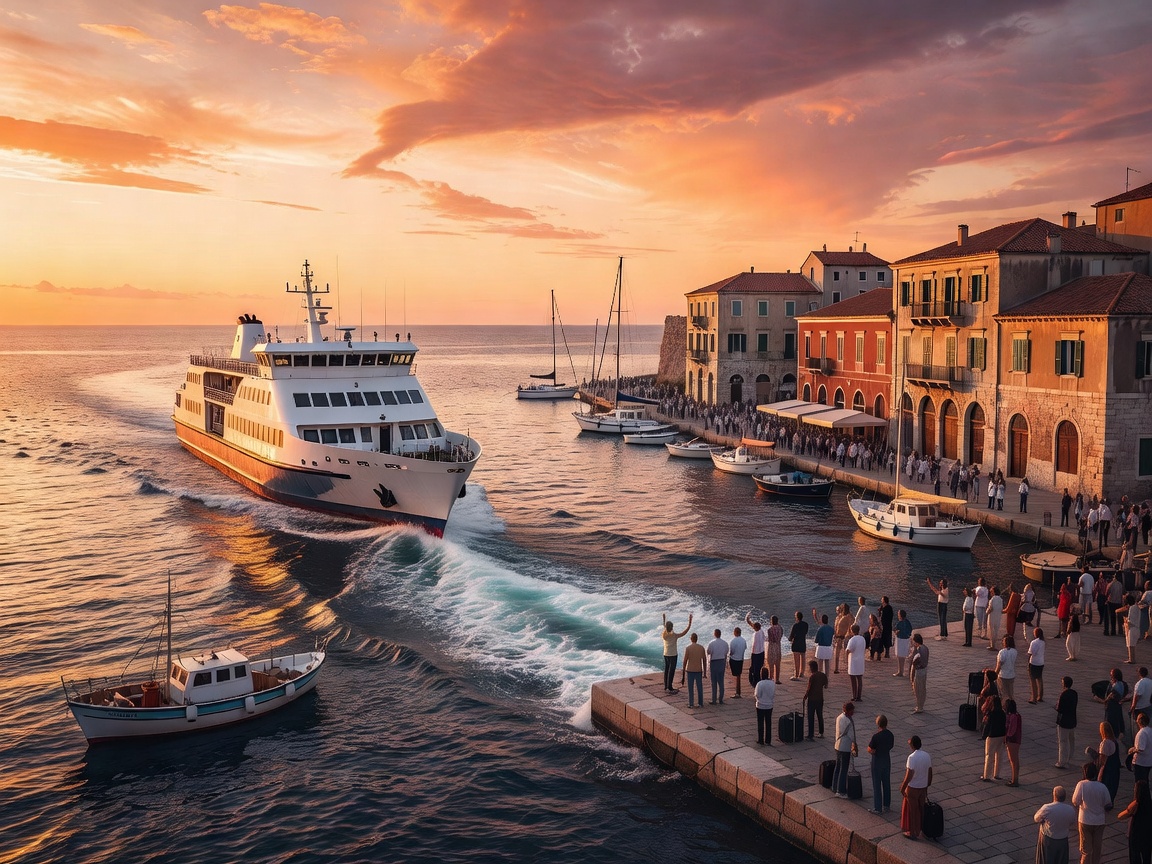
Overview of the Mediterranean Network
The Mediterranean Sea is one of the most historically and economically significant bodies of water globally, heavily reliant on maritime transport to connect Southern Europe, North Africa, and the Middle East. The ferry network here is characterized by high seasonality, immense variations in vessel types, and the sheer volume of routes operating across multiple national jurisdictions.
Unlike river ferries or brief strait crossings, many Mediterranean routes operate as overnight cruise ferries. They serve a dual purpose: efficiently transporting heavy Roll-on/Roll-off (Ro-Ro) cargo while offering passenger amenities comparable to short-haul cruise ships.
Key Corridors and Operators
The Mediterranean is subdivided into several distinct operational theaters, each dominated by specific operators and route characteristics.
The Adriatic Sea
Connecting Italy's eastern coast (ports like Ancona, Bari, and Venice) with Croatia, Albania, and Greece (Igoumenitsa, Patras), the Adriatic corridor is vital for freight moving between Central Europe and the Balkans/Levant. Operators in this region frequently utilize large, high-capacity vessels capable of handling hundreds of articulated lorries alongside thousands of passengers.
The Western Mediterranean
This sector covers routes between Spain (Barcelona, Valencia) and the Balearic Islands, as well as connections from France (Marseille, Toulon) and Italy (Genoa, Civitavecchia) to Corsica, Sardinia, and North Africa (Morocco, Algeria, Tunisia). The traffic here sees immense summer peaks driven by tourism and the annual return of the diaspora to North Africa.
The Aegean and Eastern Mediterranean
Greece relies on an extensive network to sustain its thousands of islands. The port of Piraeus is one of the busiest passenger ports in Europe. The Aegean network features a mix of massive conventional ferries serving main hubs (like Crete and Rhodes) and high-speed catamarans or hydrofoils serving smaller Cycladic islands.
Vessel Types and Specifications
Because of the varied demands, operators deploy diverse fleets:
- Ro-Pax Ferries: The workhorses of the Mediterranean. Designed to carry a mix of commercial freight vehicles, passenger cars, and foot passengers. They often feature hundreds of cabins, multiple dining options, and significant freight deck space (measured in lane meters).
- High-Speed Craft (HSC): Catamarans and monohulls that sacrifice heavy freight capacity for speed. They frequently operate at 30 to 40 knots, cutting travel times in half on shorter island routes.
- Dedicated Ro-Ro: Focused almost entirely on freight, with limited passenger capacity (usually capped at 12 drivers). These are critical for regional supply chains.
Environmental and Regulatory Shifts
The maritime industry is undergoing a strict regulatory overhaul. The International Maritime Organization (IMO) introduced stringent sulfur emission caps in 2020. The Mediterranean was subsequently designated as an Emission Control Area (ECA), forcing operators to drastically cut sulfur oxide emissions.
To comply, ferry operators have adopted several strategies. Older vessels have been retrofitted with exhaust gas cleaning systems (scrubbers). Newer acquisitions are increasingly being designed to run on Liquefied Natural Gas (LNG), which virtually eliminates sulfur emissions and significantly reduces nitrogen oxides and particulate matter. Furthermore, major ports like Barcelona and Genoa are investing heavily in "cold ironing" infrastructure, allowing ferries to plug into the onshore power grid while docked, cutting port-side emissions to zero.
Pros and Cons of Mediterranean Ferry Travel
| Aspect | Advantage | Challenge |
|---|---|---|
| Capacity | Allows passengers to travel with personal vehicles, eliminating the need for rental cars. | Loading and unloading can be time-consuming, extending total journey times. |
| Comfort | Overnight sailings in cabins save on hotel costs and prevent driving fatigue. | Rough seas, particularly in winter (e.g., the Mistral winds), can cause significant discomfort. |
| Environmental Impact | More carbon-efficient per passenger/ton than short-haul aviation. | Older vessels still contribute to localized port pollution until upgraded. |